Your eyes can tell you a lot about your overall health, but it is easy to put off an eye exam when you can still see well enough to work, drive, read, or use your phone.
Some vision problems develop gradually, while others can appear suddenly. More importantly, certain eye diseases may cause few or no noticeable symptoms in their early stages. The National Eye Institute notes that a comprehensive dilated eye exam can help detect eye disease before vision loss occurs.
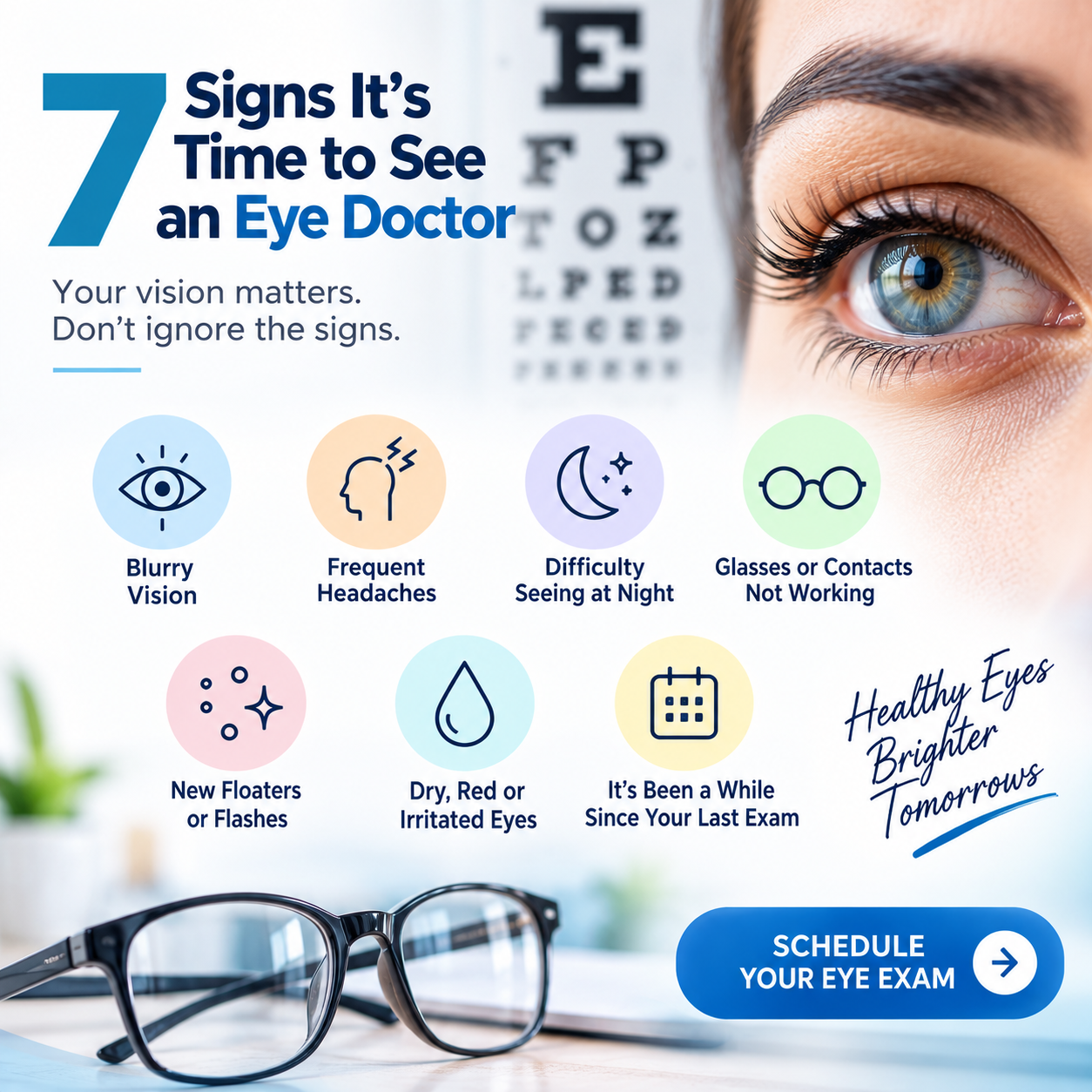
If you have been searching for an eye doctor in Monroe, NY, here are seven signs that it may be time to schedule an eye exam.
1. Your Vision Is Becoming Blurry
Blurry vision is one of the most obvious reasons to visit an eye doctor.
You may notice difficulty reading small print, seeing road signs clearly, focusing on your computer screen, or recognizing objects at a distance. You might also find yourself squinting more frequently.
Blurred vision can result from common refractive errors such as nearsightedness, farsightedness, astigmatism, or presbyopia. The National Eye Institute identifies blurred vision as the most common symptom of refractive errors and notes that an eye exam can diagnose these conditions.
However, blurry vision can also occur with other eye conditions, so persistent or changing vision should not automatically be assumed to mean you simply need stronger glasses.
If your vision is no longer as sharp as it used to be, a comprehensive eye exam in Monroe, NY can help determine what is causing the change.
2. You’re Experiencing Frequent Headaches or Eye Strain
Do your eyes feel tired after spending time on a computer? Are you experiencing headaches after reading, working, driving, or using digital devices?
Frequent headaches and eye strain can sometimes be associated with an outdated prescription, focusing difficulties, uncorrected refractive errors, or prolonged visual demands. The National Eye Institute lists headaches, eye strain, squinting, and trouble focusing while reading or using a computer among possible symptoms of refractive errors.
An eye doctor can evaluate your vision and determine whether a prescription change or another eye-related issue may be contributing to your symptoms.
If your work involves long hours in front of computers, tablets, or smartphones, an examination can also provide an opportunity to discuss digital eye strain and ways to make screen use more comfortable.
3. You’re Having Trouble Seeing at Night
Night driving can become more difficult when your vision changes.
You may notice:
- Difficulty reading road signs after dark
- Increased glare from headlights
- Halos around lights
- Trouble adjusting between bright and dark environments
- Reduced confidence while driving at night
These symptoms deserve attention, particularly if they are becoming progressively worse.
For example, the National Eye Institute lists difficulty seeing at night, sensitivity to light, glare, halos, blurry vision, and faded colors among possible symptoms of cataracts.
An eye examination can help determine whether your night-vision difficulties are related to your prescription, cataracts, or another eye-health concern.
4. Your Glasses or Contact Lenses Don’t Seem to Work as Well
If you already wear corrective lenses but find yourself struggling to see clearly, your prescription may have changed.
Signs can include holding reading material farther away, moving closer to the television, increasing the font size on your phone, squinting, or feeling that one eye sees better than the other.
The National Eye Institute recommends getting an eye exam if you wear glasses or contacts and continue to experience blurry vision, headaches, eye strain, or focusing problems.
Your vision can change over time due to age, refractive changes, medical conditions, medications, or changes in eye health.
Rather than simply tolerating reduced clarity, schedule an eye exam in Monroe, NY to determine whether your prescription needs to be updated.
5. You Notice New Floaters, Flashes, or a Shadow in Your Vision
A few longstanding floaters may be common, particularly with age. But suddenly developing many new floaters or flashes of light requires prompt attention.
The American Academy of Ophthalmology advises seeking immediate evaluation for a sudden increase in floaters or flashes, a shadow in peripheral vision, or a gray curtain covering part of your vision because these can be warning signs of a retinal tear or retinal detachment.
Mayo Clinic similarly advises immediate eye-specialist evaluation for sudden new floaters, flashes, a curtain-like area, or peripheral vision loss.
Do not wait for a routine appointment if these symptoms appear suddenly. Seek urgent eye care.
6. Your Eyes Are Frequently Red, Dry, Burning, or Irritated
Occasional eye irritation can happen to almost anyone. Persistent symptoms are different.
You may experience:
dryness, burning, itching, excessive tearing, redness, a gritty sensation, light sensitivity, or discomfort while wearing contact lenses.
These symptoms can have many possible causes, ranging from environmental irritation and prolonged screen use to dry-eye problems or other eye conditions.
If over-the-counter remedies are not helping or your symptoms continue to return, an eye examination can help identify possible causes and guide appropriate care.
At David Wasserlauf, OD, PC, Medical Eye Care in Monroe, NY includes evaluation of concerns such as dry eye, eye infections and inflammation, glaucoma risk, diabetic eye changes, and other eye-health conditions.
7. It Has Been a Long Time Since Your Last Comprehensive Eye Exam
You do not need to wait until something feels wrong to visit an optometrist in Monroe, NY.
Some eye diseases develop without obvious warning signs. Glaucoma, for example, often has no symptoms at first and can gradually affect peripheral vision. A comprehensive dilated eye examination is an important way to detect the disease.
The National Eye Institute also notes that dilated exams can help eye doctors check for conditions including glaucoma, diabetic retinopathy, and age-related macular degeneration.
Your recommended exam schedule depends on factors such as your age, medical history, family history, current eye health, medications, and risk factors.
Even if you believe your vision is fine, regular eye examinations can play an important role in protecting your long-term eye health.
Don’t Ignore Sudden Vision Changes
Some eye symptoms should not wait for your next routine examination.
Seek prompt or emergency medical attention for symptoms such as sudden vision loss, sudden severe blurring, intense eye pain, new flashes with numerous floaters, or a dark curtain or shadow across your vision. The American Academy of Ophthalmology identifies sudden vision loss and new flashes or floaters among changes that require immediate evaluation.
Intense eye pain accompanied by red eye, blurry vision, or nausea can also occur with acute angle-closure glaucoma and requires urgent medical attention.
When vision changes suddenly, it is safer to have the problem evaluated promptly rather than waiting to see whether it improves on its own.
Why Comprehensive Eye Exams Matter
A comprehensive eye examination goes beyond simply determining whether you need glasses.
Depending on your needs, an eye exam may evaluate visual acuity, refractive error, peripheral vision, eye-muscle function, pupil response, eye pressure, and the internal structures of the eye. Dilation can allow the eye doctor to examine the retina and optic nerve more closely.
This is particularly important because some eye conditions may begin before you notice significant changes in your everyday vision.
Who May Need Eye Exams More Frequently?
Some people may require closer monitoring based on their health and risk factors.
For example, the National Eye Institute recommends that people with diabetes receive comprehensive dilated eye examinations at least annually because diabetic retinopathy may initially have no symptoms.
Age, family history of glaucoma, high blood pressure, existing eye disease, contact-lens use, medications, previous eye surgery, and other factors can also affect how frequently an individual should be examined.
Your eye doctor can recommend an examination schedule based on your personal risk factors.
Looking for an Eye Doctor in Monroe, NY?
If you recognize any of these signs—or simply haven’t had your eyes checked recently—it may be time to schedule an appointment.
At David Wasserlauf, OD, PC, patients can receive comprehensive eye care in Monroe, NY, including eye exams, vision correction, specialized contact lenses, medical eye care, digital eye strain evaluation, and pre- and post-surgical eye care.
Whether you’re experiencing blurry vision, eye strain, changes in your prescription, dry-eye symptoms, or simply need a routine comprehensive eye exam, having your eyes evaluated can help you better understand your vision and eye health.
Schedule Your Eye Exam in Monroe, NY
Author: Michael Clarke