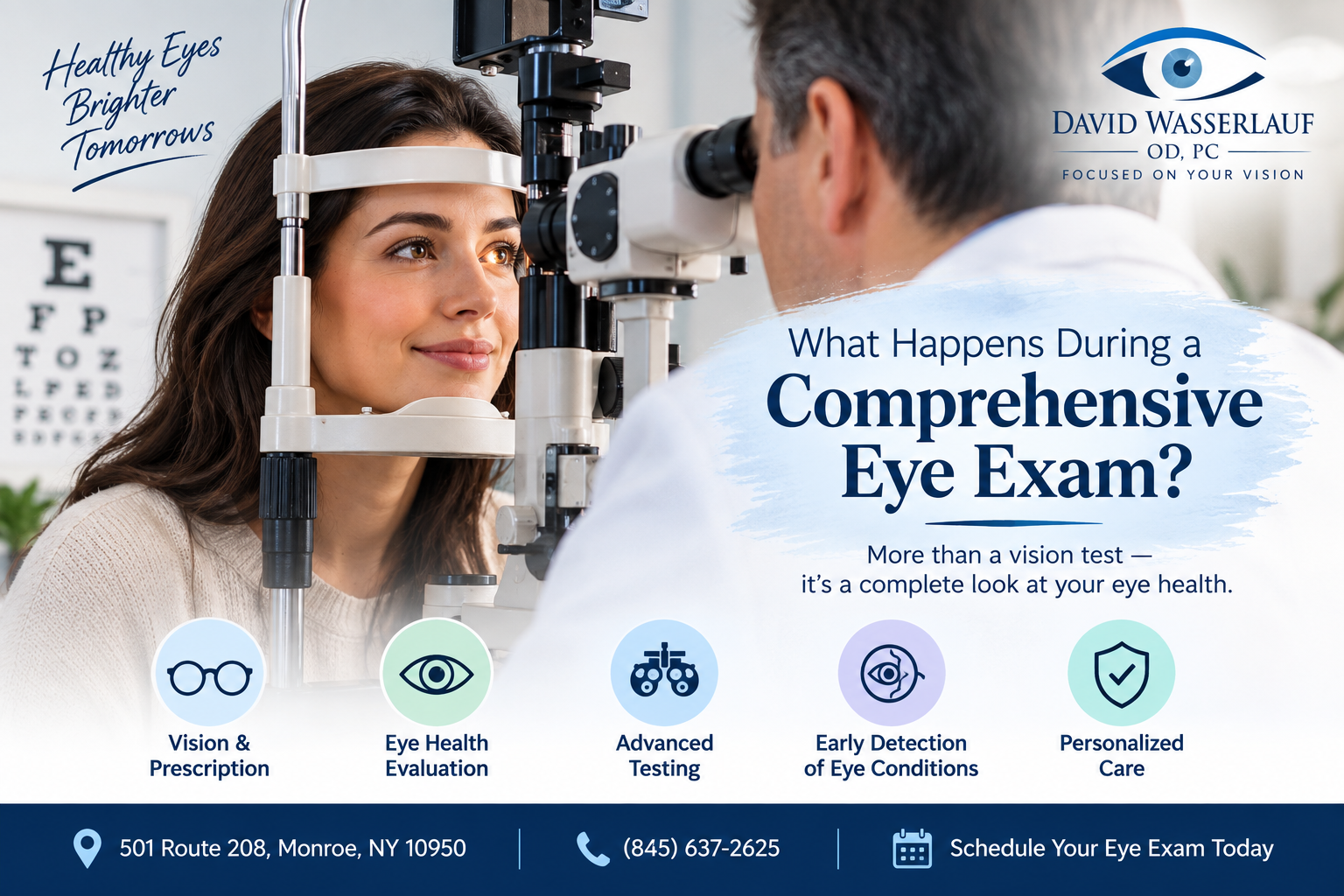
Many people schedule an eye appointment only when their vision becomes blurry or they need a new prescription. But a comprehensive eye exam involves much more than determining whether you can read letters on an eye chart.
A comprehensive exam allows your optometrist to evaluate your vision, prescription needs, eye coordination, and overall eye health. It may also help identify signs of certain eye diseases before you notice significant changes in your vision.
At David Wasserlauf, OD, PC, located at 501 Route 208 in Monroe, NY, comprehensive eye exams are designed to help patients understand their vision and maintain their eye health through personalized, professional care.
So, what actually happens during an eye exam? Here’s what you can generally expect.
1. Your Eye Exam Starts With Your Health and Vision History
Before testing your vision, your eye doctor will typically discuss your medical and eye-health history.
You may be asked about your current vision, previous glasses or contact lenses, eye problems or surgeries, medications, medical conditions, family history of eye disease, and any symptoms you’ve recently noticed.
This information matters because your eyes don’t exist separately from the rest of your body. Conditions such as diabetes and high blood pressure, along with certain medications and family history, can influence your eye health.
This is also the time to mention concerns such as blurry vision, headaches, eye strain, dry or irritated eyes, difficulty driving at night, flashes or floaters, or changes in your ability to focus.
Don’t assume a symptom is too minor to mention.
2. Visual Acuity Testing: How Clearly Can You See?
One of the most familiar parts of a comprehensive eye exam is the visual acuity test.
You’ll usually be asked to read letters or symbols of decreasing size from an eye chart. Each eye is tested individually and then, when appropriate, together.
You’ve probably heard the term 20/20 vision. This is a measurement of visual acuity, but it doesn’t tell the entire story about your eye health.
Someone can have excellent visual acuity and still have an eye condition that requires attention.
That’s one reason a comprehensive eye exam goes beyond the eye chart.
3. Checking Your Eyeglass or Contact Lens Prescription
If your vision isn’t as clear as it should be, your optometrist may perform a refraction test to determine whether you need corrective lenses or whether your existing prescription has changed.
This is the part of the examination where you may hear:
“Which looks clearer—one or two?”
Different lenses are presented while you compare which provides sharper vision.
The results can help determine whether you have common refractive errors such as:
Nearsightedness (myopia) — distant objects may appear blurry.
Farsightedness (hyperopia) — close vision may be more difficult, although symptoms vary.
Astigmatism — irregular focusing can contribute to blurred or distorted vision.
Presbyopia — age-related changes in near focusing that commonly become noticeable after age 40.
Your prescription can change gradually, which is why periodic eye exams remain useful even if your current glasses seem adequate.
4. Testing How Your Eyes Work Together
Good vision isn’t simply about how clearly each eye sees individually.
Your eyes must also coordinate effectively.
During a comprehensive eye exam, your optometrist may assess eye movement, alignment, focusing ability, and how well your eyes work together.
Problems in these areas can sometimes contribute to symptoms such as eye fatigue, difficulty concentrating while reading, headaches, or discomfort during prolonged near work.
For people who spend many hours working on computers, phones, and tablets, discussing these symptoms can be particularly useful.
5. Evaluating Your Pupils
Your pupils provide useful information about how your eyes respond to light.
Your eye doctor may shine a light toward each eye to observe pupil size and reaction.
This is a quick and painless part of the examination and contributes to the overall evaluation of your visual system.
6. Examining the Front of Your Eyes
Your optometrist may use a specialized microscope called a slit lamp to examine structures at the front of your eyes in detail.
This can include the eyelids, eyelashes, conjunctiva, cornea, iris, lens, and other visible structures.
The examination may help identify signs associated with conditions such as dry eye, inflammation, infection, corneal problems, and cataracts.
If you’ve been experiencing burning, itching, redness, excessive tearing, light sensitivity, or a gritty sensation, be sure to mention these symptoms during your appointment.
7. Checking Eye Pressure
Eye pressure testing—also known as tonometry—may be included as part of your examination.
Measuring intraocular pressure can provide information used when evaluating your risk for glaucoma, although eye pressure alone doesn’t determine whether someone has glaucoma.
Depending on the equipment and examination, eye pressure can be measured in several ways.
Some people remember the traditional “air puff,” but other methods of measuring eye pressure are also commonly used.
8. Examining the Retina and the Back of the Eye
An important part of a comprehensive eye examination is evaluating structures toward the back of the eye.
Depending on your individual needs and the examination performed, your optometrist may evaluate the retina, optic nerve, blood vessels, and macula.
These structures play essential roles in healthy vision.
Examining them can help your eye doctor look for signs associated with conditions such as glaucoma, retinal problems, macular changes, and eye complications related to systemic diseases such as diabetes.
Will My Eyes Need to Be Dilated?
Not every examination is identical.
Your optometrist may recommend dilating eye drops depending on your age, symptoms, health history, risk factors, and what needs to be examined.
Dilation temporarily enlarges the pupils, giving your eye doctor a broader view of the structures inside the eye.
After dilation, you may experience temporary light sensitivity or blurry near vision. Your eye doctor can explain what to expect if dilation is recommended.
9. Screening for Signs of Eye Disease
One of the most important reasons to schedule regular comprehensive eye exams is that some eye conditions can develop with few noticeable symptoms in their earlier stages.
A comprehensive examination may help your eye doctor evaluate for signs or risk factors associated with conditions such as:
- Glaucoma
- Cataracts
- Diabetic eye disease
- Macular changes
- Dry eye disease
- Corneal conditions
- Retinal abnormalities
An eye exam does not mean your doctor expects to find a problem. It provides an opportunity to establish a baseline, monitor changes and identify concerns that may require further evaluation.
Is an Eye Exam the Same as a Vision Screening?
Not necessarily.
A basic vision screening may identify whether you have difficulty seeing clearly at certain distances.
A comprehensive eye exam, however, provides a much broader evaluation.
It can assess your visual acuity and prescription while also examining how your eyes function and evaluating the health of different eye structures.
Passing a basic vision screening therefore doesn’t necessarily mean that every aspect of your eye health has been evaluated.
How Long Does a Comprehensive Eye Exam Take?
The length of an appointment varies depending on the tests required, whether dilation is performed, your medical and eye history, and whether you have specific concerns that need additional evaluation.
Instead of focusing on a particular number of minutes, plan enough time for your optometrist to perform the appropriate examination and discuss the findings with you.
If additional testing is recommended, your eye doctor should explain why it may be helpful.
How Often Should You Have a Comprehensive Eye Exam?
There isn’t one schedule that’s appropriate for every person.
How frequently you should have an eye exam can depend on your age, vision, medical history, family history, contact lens use, medications and risk factors for eye disease.
People with diabetes, existing eye conditions, certain medical conditions, significant family histories, or other risk factors may need more frequent examinations.
Your optometrist can recommend an examination schedule based on your individual circumstances.
Do You Need an Eye Exam If Your Vision Seems Fine?
Potentially, yes.
Clear vision doesn’t always mean that every aspect of your eye health is normal.
Some conditions can develop before they cause obvious symptoms. A routine comprehensive examination gives your eye doctor an opportunity to evaluate more than whether you need glasses.
Regular eye care can also establish a history of your eye health, making it easier to recognize meaningful changes over time.
What Should You Bring to Your Eye Exam?
To make your appointment as useful as possible, consider bringing your current eyeglasses, contact lenses, or prescription information, a list of medications, relevant medical information, and your insurance information if applicable.
It can also help to make a short list of questions or symptoms beforehand.
If you’ve noticed a change in vision, tell your eye doctor when it started, whether it affects one or both eyes, and whether it’s constant or intermittent.
The more useful information you provide, the better your optometrist can understand your concerns.
What Happens After the Eye Exam?
After completing the appropriate tests, your optometrist will discuss the findings with you.
Depending on the results, you may be told that your eyes appear healthy and your prescription remains appropriate, receive an updated eyeglass or contact lens prescription, be given recommendations for managing a specific concern, or be advised to have additional testing or follow-up care.
If a condition requires care from another eye specialist or healthcare professional, appropriate referral or coordination may also be recommended.
Don’t hesitate to ask questions about your results. Understanding your eye health is an important part of taking care of your vision.
Looking for a Comprehensive Eye Exam in Monroe, NY?
If you’re searching for a comprehensive eye exam in Monroe, NY, an eye doctor near me, or an optometrist in Monroe, NY, David Wasserlauf, OD, PC provides personalized eye care for patients in Monroe and the surrounding area.
Whether you’re experiencing changes in your vision, need an updated prescription, wear contact lenses, or simply want to stay proactive about your eye health, a comprehensive examination is a valuable place to start.
Author: Michael Clarke